Culture Fit Is Dead: Here Is Why Culture Add Is Replacing It
Hiring for culture fit builds comfortable teams that think alike and miss the same things. Here is what culture add means, why it works better, and how to actually hire for it.
For the better part of two decades, culture fit was treated as one of the most important hiring signals a company could have. You had great skills? Good. But did you fit? Would you get along with the team? Would the team want to get a coffee with you? These questions were asked sincerely, taken seriously, and used to approve or reject candidates who might otherwise have transformed those organisations entirely. The consequences are now hard to ignore.
Hiring for culture fit systematically reproduces the demographics, cognitive patterns, and blind spots that already exist in a team. It optimises for comfort over capability. It builds teams that feel cohesive while becoming progressively more fragile and less able to see the problems they are most likely to create.
In 2026, the most forward-thinking HR leaders have moved on. The question is no longer “does this candidate fit our culture?” The question is “what does this candidate add to it?” and whether they strengthen how the team actually operates.
What Was Really Wrong With Culture Fit
The concept of culture fit was never neutral. When a hiring manager says a candidate “does not feel right” or “would not be a good fit,” they are almost never making an objective assessment. They are pattern-matching against who is already in the room.
The research on this is consistent. Interviewers make more favourable assessments of candidates who mirror their own communication style, educational background, and social signals. This is not malicious. It is human. But the cumulative effect, applied across hundreds of hiring decisions over years, is organisational cloning.
A team that only hires culture fits becomes a team that only thinks one way, only communicates in one register, and only approaches problems from one angle. The initial sensation is cohesion and ease. The eventual outcome is strategic brittleness.
The technology sector has been particularly vulnerable to this pattern. Engineering teams that hired entirely for cultural fit built products that failed to anticipate the needs of users who did not share their profile. Entire product categories were missed because the room had nobody who could see what the room could not see.
83%
of hiring managers admit to making poor decisions due to bias or time pressure
4%
of actual job performance variance explained by an unstructured interview
35%
more likely to achieve above-average profitability for companies in the top quartile for diversity
The Bias Hiding in Plain Sight
Culture fit is also one of the clearest vectors for legally and ethically problematic bias in hiring. When fit is evaluated through an unstructured interview, what gets assessed in practice is tone, presentation, social ease, name pronunciation, accent, and the felt sense of rapport. These signals consistently disadvantage candidates from underrepresented groups, neurodivergent candidates, and candidates who simply do not share the social comfort of the interviewers in the room.
The intent is rarely discriminatory. The outcome often is. And in 2026, with the EU AI Act and strengthened EEOC guidance both increasing scrutiny on hiring processes, using “culture fit” as an undocumented selection criterion carries real legal risk alongside the obvious ethical one.
When everyone in the room thinks the same way, the team reaches consensus quickly and misses the same things every time. Culture fit optimises for the first part while guaranteeing the second.
What Culture Add Actually Means
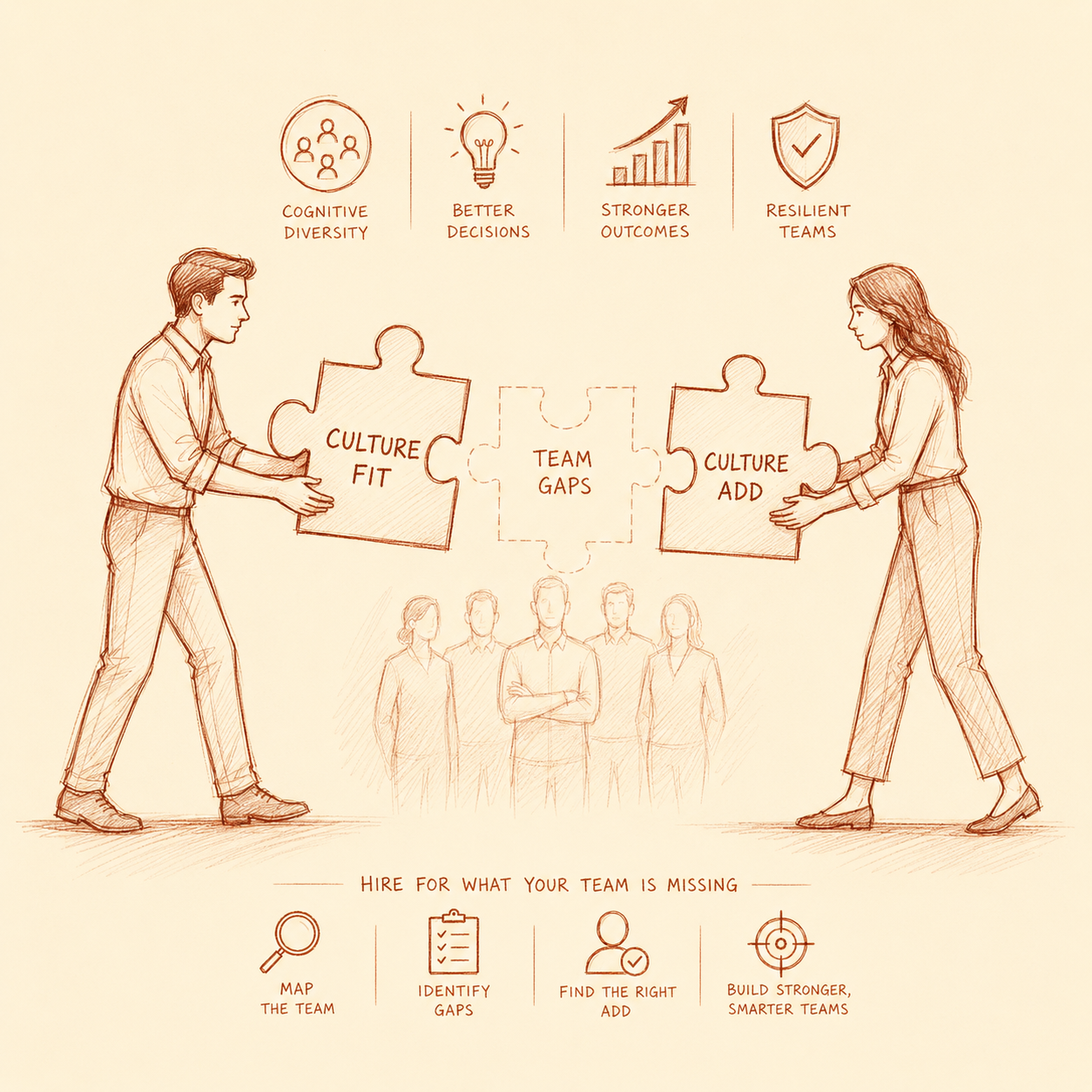
Culture add is a fundamentally different question. Instead of asking whether a candidate matches the existing team, it asks what a candidate brings that the team currently lacks.
This requires two things that are harder than they sound.
First, the hiring organisation needs an honest understanding of what the existing team's operational profile actually looks like. Where does the team excel? What cognitive patterns dominate? Where does the team have blind spots, problems it keeps approaching the same way without finding better options?
Second, it requires knowing what the team is missing. Not just skills. Cognitive diversity. Decision-making styles. Communication approaches. Perspectives shaped by different operational histories. The question shifts from “does this candidate match us?” to “does this candidate complete us?”
Old approach
Culture Fit
Would I enjoy working with this person?
- Subjective gut feel in interviews
- Mirrors existing team demographics
- Reinforces existing blind spots
- Builds teams that feel cohesive but think alike
- Documented vector for unconscious bias
- Optimises for comfort, not capability
Better approach
Culture Add
What does this person bring that we do not have?
- Based on observable decisions and behaviour
- Maps against team operational gaps
- Deliberately introduces productive friction
- Builds teams with cognitive diversity
- Reduces surface area for bias
- Optimises for collective capability
Why Cognitive Diversity Is a Business Outcome, Not an HR Initiative
The correlation between cognitive diversity and better business outcomes has been studied extensively. The findings are consistent across industries and company sizes.
Teams with greater diversity of thought, decision-making style, and operational background produce better solutions to novel problems, make fewer systematic errors, and generate higher revenue from innovation. A McKinsey analysis found that companies in the top quartile for diversity were significantly more likely to achieve above-average profitability than their less diverse peers.
The mechanism is direct. When everyone in the room approaches a problem from a similar angle, the group reaches consensus quickly and misses the same things every time. When the room contains people who see the problem differently, consensus is harder to reach but the solution is more robust.
A product team that contains engineers who prioritise system integrity alongside engineers who prioritise deployment velocity will build better, more resilient products than a team composed entirely of either type. Both kinds of judgment are necessary. Neither alone is sufficient.
That is what culture add hiring enables. Not diversity as a compliance checkbox. Diversity as a deliberate engineering of the team's cognitive portfolio.
The Four Questions You Need to Answer Before You Open a Role
To hire for culture add with any precision, you need clear answers to four questions before you write the job description or screen a single candidate.
01
What does our team's operational baseline actually look like?
How do we make decisions? At what pace? With what tolerance for ambiguity? What is our ratio of velocity-oriented to risk-mitigation-oriented thinkers?
02
Where are our active gaps right now?
Are there situations where we keep defaulting to the wrong type of decision? Is there a persistent blind spot around technical debt, client communication, or cross-functional handoffs?
03
What cognitive profile would address those gaps?
Not skills. Cognitive approach. You are not looking for someone who knows more. You are looking for someone who thinks differently in the specific ways your team needs right now.
04
How do we validate that a candidate actually has that profile?
This is where traditional hiring fails. You cannot assess cognitive approach reliably through a resume or interview. You can only assess it by watching someone make real decisions under realistic conditions.
The last question is the most important. And it is exactly why work simulation assessments, where candidates navigate real operational scenarios and reveal their decision-making logic in action, are the only reliable mechanism for identifying genuine culture add.
The Difference in Practice: A Side-by-Side Example
Consider two candidates for a senior DevOps role on a team that has a well-documented blind spot around deployment risk.
Candidate A — The Culture Fit
Comes from a high-velocity startup background. Has deployed hundreds of features fast. Her instinct is to move, iterate, and fix in production. She interviews extremely well because she thinks exactly like the existing team. She will feel like a fit immediately. On day one, everyone will love her.
Verdict: Deepens the team's existing strength. Also deepens its existing blind spot around deployment risk.
Candidate B — The Culture Add
Comes from a large financial services engineering team. His instinct is to halt, document, and validate before merging. He slows down when risk is visible. He has built systems that have run without incident for years. He is a less comfortable hire because he thinks differently to the team. He will create friction early on.
Verdict: Introduces exactly the risk-mitigation discipline the team is missing. The friction he creates is productive. It catches the deployment errors that currently cost three days of incident response every quarter.
Culture fit hiring selects Candidate A every time. She feels right. She interviews well. She will be welcome on day one.
Culture add hiring, informed by an accurate map of the team's current profile and gaps, selects Candidate B. Not because he is more skilled. Because his presence makes the team collectively smarter in the specific way it needs to be.
The vibe trap: “Would I enjoy working with this person?” is not a performance question. It is a social comfort question. The two have different answers. When you optimise for the first, you get teams that feel great together but consistently underperform on the problems that matter most.
Why Shared Values and Shared Thinking Are Not the Same Thing
One of the most persistent defences of culture fit hiring is that cultural cohesion genuinely does matter for team performance. Teams that trust each other, share core values, and communicate in compatible ways do perform better. So assessing fit is legitimate, the argument goes.
This argument conflates two things that are genuinely distinct.
Shared values are a commitment to quality, honesty, and customer outcomes. These are legitimate hiring criteria. They are also not what most culture fit assessments actually measure.
Shared cognitive patterns are the tendency to approach problems the same way, communicate in the same register, and make the same types of trade-offs. This is what culture fit assessments actually evaluate. And this is exactly where the model breaks down, because shared cognitive patterns are the enemy of organisational resilience.
You can hire people with deeply shared values and genuinely different cognitive profiles. In fact, that is the goal. A team united by a shared commitment to customer outcomes but composed of people who think differently about how to achieve those outcomes is far more capable than a team that is united by both.
How to Move From Culture Fit to Culture Add in Your Hiring Process
- Map the team before you write the job description. Spend 20 minutes documenting your team's current operational profile. Where does it default? What does it consistently miss? What types of decisions does it make well and where does it keep making the same mistakes? This becomes your add specification, the actual thing you are trying to hire for.
- Rewrite job descriptions around cognitive style, not just credentials. Tell candidates what kind of thinking environment they are joining, not just what skills you need. “We move fast and need someone who can slow us down when it matters” is more useful than “strong communication skills required.”
- Replace subjective fit questions with structured behavioural scenarios. Stop asking “would I enjoy working with this person?” and start watching how they make decisions when the trade-offs are real. A structured scenario where the candidate chooses between moving fast and protecting quality tells you far more than any personality read in an interview room.
- Score candidate choices against your team's documented gaps. The question is not just “did they make a good decision?” It is “did their decision reveal the cognitive orientation that our team is currently missing?” These are different evaluations and the second one requires you to have done the team mapping first.
- Use work simulation data to have an honest pre-offer conversation. Share what the simulation revealed with the final candidate before the offer goes out. Talk openly about where they match and where there might be friction. A candidate who understands and accepts that friction going in is far more likely to navigate it successfully than one who discovers it on day fifteen.
The Bottom Line
Culture fit had a long run. It built comfortable teams, streamlined interview processes, and delivered a sense of cohesion that felt like strength.
In 2026, the evidence is clear that it also built fragile organisations, reproduced systemic bias at scale, and left companies unable to see the problems they were most likely to create.
Culture add is not a diversity and inclusion rebrand. It is a strategic upgrade to how teams are built. It asks harder questions, requires more self-awareness from hiring managers, and demands that you understand your team before you evaluate anyone new.
The organisations that make this shift, hiring not for comfort but for collective capability, are building the teams that will consistently outperform the ones still asking whether a candidate would be fun to work with.
The question is not whether the team will enjoy working with this person on day one. The question is whether the team will be measurably better because this person is in it.
Pair culture add with measurable hiring signals: operational fit, candidate-friendly assessments, and EU AI Act-compliant tooling so diversity in thinking translates into better retention, not just better interviews.
Find out what your team is actually missing before your next hire
Valentiq maps your team's current operational profile and identifies the cognitive gaps your next hire should address. Work simulations reveal real decision-making patterns, not interview performance. EU AI Act compliant. Zero biometric data.
Book a demo →Agentic hiring simulations for operational-fit decisions.
See a demo →